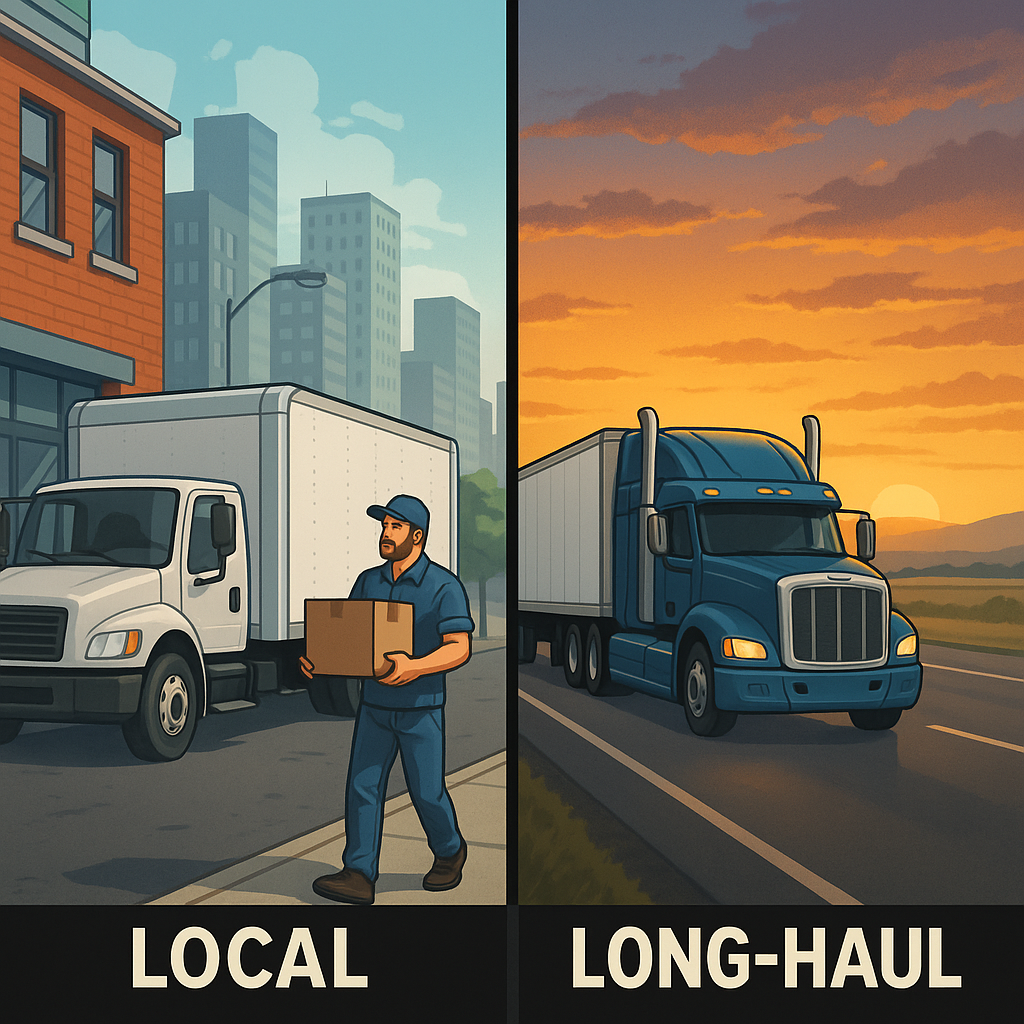
The contemporary society characterized by a fast-paced transportation industry is the optimal place for transportation companies seeking to gain efficiency and improve the economy through the perfect combination of local truck drivers and long-haul truck drivers. Long-haul drivers are different from their local counterparts in terms of the difficulty of their tasks. Short-haul drivers are usually the ones who drive short distances and return at the end of the day while long-haul drivers travel around for more than one day across the country. The selection of the right drivers for respective positions lies in the understanding of their different tasks by the transportation companies.
Local vs. Long‑Haul Comparison
A local driver is a driver who generally moves around a certain geographical area such as a city or a metropolitan area. As such, they are generally more scheduled like starting and finishing daily to delivery points they have known and sleeping in a hotel only a few times a month. This feature can attract those looking to achieve the right work-life balance. Besides, local routes are often characterized by multiple stops, lighter loads, and shorter timeframes—freight demanding excellent customer service skills and the ability to navigate through city traffic and regulations.
Unlike the regional drivers, the long-haul drivers go for long distances that could reach hundreds or even thousands of miles. They may stay for a couple of weeks far from their homes where they are bound by federal laws of Hours-of-Service and must cross a number of state lines with different regulations. Endurance, flexibility, and the experience of moving different types of cargo, under different weather are some of the attributes demanded by these routes. For most truck drivers, the higher pay is the main attraction as a result of personal sacrifices in budgets and time on the road.
Focus Areas in Hiring Local Drivers
- Flexibility vs. Routine Scheduling
- Local routes generally have regular drops like early morning start times and drop-off times. Promote your job vacancies with the mentioned predictable schedules to attract candidates who are better at routine.
- Highlight the opportunities for overtime on peak days which can increase overall compensation without enhanced travel.
- Local routes generally have regular drops like early morning start times and drop-off times. Promote your job vacancies with the mentioned predictable schedules to attract candidates who are better at routine.
- Communication with Customer & Service Skills
- The local drivers would rather pass the goods directly to customers or warehouse personnel. Use customer-service scenario questions at the interview to check the level of professionalism and communication skills.
- Demonstrate a delivery scenario to evaluate how candidates deal with delays, special instructions, or recipients who are not satisfied.
- The local drivers would rather pass the goods directly to customers or warehouse personnel. Use customer-service scenario questions at the interview to check the level of professionalism and communication skills.
- Acquaintance with Local Rules & Traffic Patterns
- Give priority to those candidates who have experience with your specific operating area’s traffic laws, parking restrictions, and industrial areas.
- Be friends with local vocational schools or CDL training centers that will provide regional route training.
- Give priority to those candidates who have experience with your specific operating area’s traffic laws, parking restrictions, and industrial areas.
- Vehicle Skills & Equipment Proficiency
- Some of the local hauls might require the use of a lift gate, pallet jacks, or driving dock loaders, hence a practical test on the knowledge of equipment should be conducted at the time of application.
- Regular technology workshops on the new cabs (GPS, ELD) will be your way of showing the drivers that you care about their success.
- Some of the local hauls might require the use of a lift gate, pallet jacks, or driving dock loaders, hence a practical test on the knowledge of equipment should be conducted at the time of application.
Focus Areas in Hiring Long‑Haul Drivers
- Routing & Licensing Compliance
- Long-haul candidates have to deal with federal regulations that cover break times, weight limits, and hazmat certifications. During the interview, assess their knowledge of the Hours-of-Service rules and electronic logging devices (ELDs).
- Provide licenses for route-planning software that is user-friendly and training to reduce errors in manual planning to enhance delivery accuracy.
- Long-haul candidates have to deal with federal regulations that cover break times, weight limits, and hazmat certifications. During the interview, assess their knowledge of the Hours-of-Service rules and electronic logging devices (ELDs).
- Tenacity & Adaptability
- Drivers should be mentally tough so ask them how they managed with breakdowns, terrible weather, and priority delivery.
- Talk about the benefits like premium pay for over-miles, per-diem, or layover compensation which may help with the challenges of the long time away from home.
- Drivers should be mentally tough so ask them how they managed with breakdowns, terrible weather, and priority delivery.
- Self-sufficiency & Problem-Solving Skills
- Long-haul drivers are the ones who solve unpredicted issues—it could be a broken machine, roads closed, or wrong shipments—without being supervised directly.
- Include situational judgment tests in your employment plan for measuring independent decision-making.
- Long-haul drivers are the ones who solve unpredicted issues—it could be a broken machine, roads closed, or wrong shipments—without being supervised directly.
- Health & Wellness Programs
- Acknowledge the toll on health from long-feature trips by incorporating health-promoting activities like gym membership, telehealth services, or healthy meal stipends at travel truck stops.
- Raise awareness on mental health resources or peer support networks that inhabit drivers who stay on the road for a longer time.
- Acknowledge the toll on health from long-feature trips by incorporating health-promoting activities like gym membership, telehealth services, or healthy meal stipends at travel truck stops.
Compounding: Local vs. Long‑Haul Hiring Techniques
| Factor | Local Drivers | Long‑Haul Drivers |
| Schedule | Predictable routes daily | Variable trips of multi-days |
| Route Familiarity | Urban/regional knowledge | Interstate and cross-country navigation |
| Customer Interaction | Frequently in person handoffs | Mostly remote communication with dispatch |
| Regulatory Complexity | State and local rules | Federal Hours-of-Service, hazmat, weight limits |
| Compensation Models | Hourly + overtime | Mileage-based pay, per-diem, layover premiums |
| Support Needs | Local orientation programs | Route-planning tools, wellness, roadside assistance |
| Turnover Risks | Lower than long-haul (due to home time) | Higher (personal/family sacrifice) |
Channels & Sources for Recruitment
- General Job Boards vs. Specialized Platforms
For the local driver positions, community sites (for instance, city job centers, regional trucking forums) are the major source of candidates that already live in the area. In contrast, national CDL trajectories or trucking-centric sites are better options for long-haul positions. Social media like Facebook for truck drivers and LinkedIn ads about “long-haul opportunities” with premium pay are also the options to explore. - Referral & Incentive Programs
Employee-referral programs are the main tool for both local and long-haul drivers. Provide various bonuses: a small bonus for local referrals and a large bonus for successful long-haul placements as they are harder to fill. This approach not only speeds up the hiring process but also takes advantage of current drivers’ networks, leading to candidates who already internally know the company culture. - Partnerships with Training Schools & CDL Academies
Create connections with vocational schools that offer CDL certifications. Arrange for the students to tour your facility, meet with the dispatch team and be informed about specific routes. For local positions arrange partnership with community colleges and for the long-haul needs, you can work with trucking academies that specialize in over-the-road training.
Selection & Interview Best Practices
- Competence & Situational Interviews
Use challenges that are close to real life instead of the standard queries: “How would you handle a missed delivery window in a 50-mile urban route?” or “What steps would you take if your ELD malfunctioned 500 miles from home?” These will reveal your knowledge of the regulative needs, the ability for problem-solving and the concern for customers. - On-the‑road Trials
Whenever possible include a test drive supervised with the local driver taking on a route with urban roads and the long-haul applicants for highways. This practical examination will help you to reveal the positives or concerns of which the resume was not able to provide.
Retention & Ongoing Support Strategies
Career Development Paths
Straightforward promotion paths: from local drivers moving to the route supervisory roles or regional management; long‑haul drivers of the trained transition to the trainer positions or safety coordinators. Indicate these paths during onboarding to demonstrate the long-term opportunities.
Flexible Scheduling Options
Utilize the schedule bidding for local drivers to increase their wish shifts, and hence, their work-life balance. For long-haul drivers, giving them the option of shorter loops or Home-weekend guarantees will help in ensuring that they do not burn out.
Wellness & Community Building
Frequent in-person or virtual meetups for drivers to come together. A driver portal can be created consisting of forums, company news, and recognition for drivers (for example, awards for safe miles driven, customer praise, etc.). Research on Trucking Talent developed with the help of local community involvement has been successful to the level of 15% employees’ retention surge within a year. Using the best way to hire an experienced long-haul truck driver online can further improve recruitment efficiency and reduce turnover.
Regulatory Compliance & Safety Culture
The knowledge of the federal, state, and local regulations remains intact and is very valuable. Engage in use of compliance software that automates HOS tracking, CSA score checking, and inspection notifications. Establish a safety culture by offering awards to drivers who have undergone safety trainings, recognizing those with no inspection issues, and sharing of best practices in a monthly newsletter.
Conclusion
The hiring process for local and long-haul truck drivers with a successful mix requires thoughtful strategies that take into account the specific needs of each position. Once you improve the applications, channels for hiring, the selection of candidates, and the support systems, your trucking company will appeal to quality drivers who can then fit their schedules with company operations. Do not forget that investment in good hiring strategies pays well through proper delivery, minor turnover, and a good reputation in the market. With strategies like flexible scheduling, competitive pay, and community involvement—some of which have been successfully executed by partners like Trucking Talent—you will be well on your way in building a versatile, driven driver workforce that is ready for every route and every challenge.
Leave a Reply